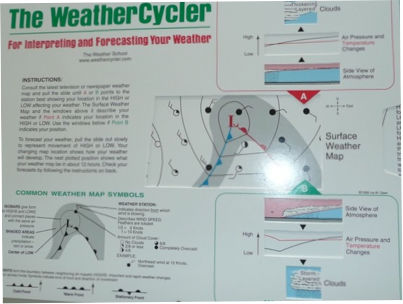

I came across a neat tool a while back that helps you visualize what’s going to happen with your weather. As you know, most weather systems in our Northern Hemisphere move from West to East. Here’s how the WeatherCycler puts this simple fact to work, to show you how your weather will change.
Simply select the current conditions and weather pattern in your area, using the slide-rule type device. Then, you’ll literally see what the conditions should be like in the next 12-hours. Things like precipitation, cloud cover, air pressure and temperature changes and wind direction and velocity changes are easy to see. If you write down or track this information, you can begin to see how you can forecast the weather in our area about as accurately as your favorite TV meteorologist!
The premise behind WeatherCycler relies on a couple basic facts:
-
• Two kinds of broad-scale weather systems dominate the weather --- Highs and Lows.
-
• Each kind of weather system has its own common characteristics, including pressure, temperature, humidity, winds, sky conditions, etc., which are organized around a center of a High or Low air pressure.
-
• Weather systems travel across the earth’s surface and carry their traits with them.
-
• Highs and Lows may shift north or south in their travels, but their major motion is from west to east.
-
• Weather now to the west of you is likely to be your weather in the near future.
Here’s a real-world example that will help you see how the major weather systems are forecast to move from west to east across the U.S. The first map below shows the forecast weather for 12-hours from now. The second panel is 24-hours later, or 36-hours from now.
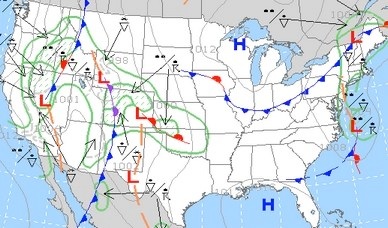
Day 1 Weather Forecast
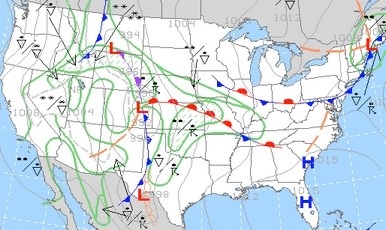
Day 2 Weather Forecast
Notice how the cold front over New Mexico on Day 1 has now moved east, over west Texas on Day 2. Also, the center of Low pressure (trough) over Colorado on Day 1, has now edged close to Kansas on Day 2, and the High in the Gulf of Mexico on Day 1 has now moved right over my old house in Orlando! What would make these weather features move faster --- or slower --- than they are forecast to move? Wind. More --- or less --- of it.
If you’ve read a lot about weather theory (and perhaps even understood half of what you read), but still have problems “connecting the dots” in the real world, the WeatherCycler could help! It’s a great way to learn (or teach) weather basics. Plus, it’s fun to try to guess what the general conditions in your area might be like in the next day or two, without having to rely on those all-too happy-go-lucky TV weather people!
The WeatherCycler costs about $10, and is available directly from www.weathercycler.com, or from Sporty’s Pilot Shop.