

During flight training we learn about the five hazardous attitudes that pilots may exhibit. You’re likely to skew toward one attitude more than the others, although you might float between different attitudes at different times, depending on flight conditions and situations. For example, you are unlikely to exhibit the “Anti-Authority” attitude on a check ride, although it might be evident when flying on your own, or with passengers you’re trying to impress.
The first step to resolving one of these attitudes is recognition of it. It’s hard to self-diagnose something like this. But now there is an on-line tool that can help determine your hazardous attitude tendencies. David Hunter’s test is posted at the Aviation Human Factors website, which you can reach by clicking here (try Version 2).

I went back and sourced the questions that contribute to that attribute, and then it began to make sense. I had strongly agreed to a couple questions regarding my enjoyment of stalls, spins and steep turns and that’s what skewed the answers for the macho attribute. A fondness for aerobatics and all things inverted and I get tagged as ‘Macho’. But that’s the whole point of the test, I would imagine. I don’t see that as being macho, but I realize someone else could get that perception based on my answers to a couple simple questions. For the record though, I have never done stalls, spins or other aerobatic maneuvers with non-pilot passengers. And I’ve never buzzed someone’s house, flown under a bridge or done any maneuvering below an altitude that allows a safe recovery. So there.
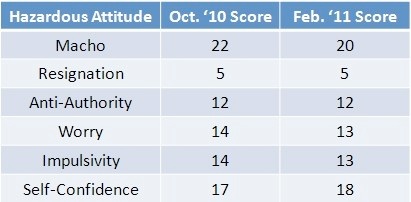
Note: David adds a sixth attitude, ‘Worry’, to his testing.
THE FIVE HAZARDOUS ATTITUDES
-
‣Anti-authority (“Don’t tell me!”). This attitude is found in people who do not like anyone telling them what to do. They may be resentful of having someone tell them what to do or may regard rules, regulations, and procedures as silly or unnecessary. However, it is always your prerogative to question authority if you feel it is in error.
-
‣Impulsivity (“Do something quickly!”). This attitude is found in people who frequently feel the need to do something— anything—immediately. They do not stop to think about what they are about to do, they do not select the best alternative, and they do the first thing that comes to mind.
-
‣Invulnerability (“It won’t happen to me!”). Many people feel that accidents happen to others, but never to them. They know accidents can happen, and they know that anyone can be affected. They never really feel or believe that they will be personally involved. Pilots who think this way are more likely to take chances and increase risk.
-
‣Macho (“I can do it!”). Pilots who are always trying to prove that they are better than anyone else are thinking, “I can do it—I’ll show them.” Pilots with this type of attitude will try to prove themselves by taking risks in order to impress others. This pattern is characteristic in both men and women.
-
‣Resignation (“What’s the use?”). These pilots do not see themselves as being able to make a great deal of difference in what happens to them. When things go well, the pilot is apt to think it is due to good luck. When things go badly, the pilot may feel that someone is out to get them, or attribute it to bad luck. The pilot will leave the action to others, for better or worse. Sometimes, such pilots will even go along with unreasonable requests just to be a “nice guy.”