

When I began flying, my instructor explained maneuvering speed this way; “If you get into rough air, just slow up below VA”. He mumbled something about structural damage and turbulence and that was about as far as we delved into it at the Private Pilot level. Later, I learned a lot more about VA; at least enough to carry on a half-way coherent conversation on the topic.

George Carlin used to joke that since the ‘Black Box’ always survived an airplane accident, maybe they should make the entire plane out of that substance. That’s very funny, and an interesting observation. Theoretically, they could, but the plane would be so heavy, and have so much drag, that it would probably require 12 engines and a huge wing just to takeoff. In the world of aircraft design, everything is a trade-off; keeping weight to a minimum is a prime objective, so the load and stress factors that an airplane can endure are always going to be limited.

Remember that as load factor increases --- such as in a steep turn or a rapid pull-up --- the stall speed also increases, at the square root of the load factor increase. So, if we were to depict on a graph this relationship between airspeed and load factor (or G-forces), we would have what is known as a V-G diagram:
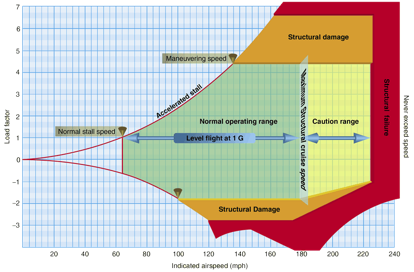
Let’s test it and see. What happens if we fly at 120MPH and try to achieve 5 or 6 G’s in this airplane? If you follow the 120MPH line up from the Y-axis, you will see that it exits the chart (over the ‘Accelerated Stall’ curve) at about 3.5G’s. What does this mean? It means that in a maneuver or configuration that produces 3.5G’s (a 60 degree bank, for example), this airplane will stall at 120MPH! And if it stalls, then there is no way to get to 4.4G’s, let alone 5 or 6 G’s! Flying below maneuvering speed will always produce a stall before it allows us to exceed the structural load limit of the airplane! Cool, huh?
NOW FOR SOMETHING NEW
So, here is the ‘new’ component of all this that I promised. The FAA issued a Special Airworthiness Information Bulletin (SAIB) last month (CE-11-17), as a result of an American Airlines crash in New York that happened a couple of months after 9/11 (yes, it took them nearly 10-years to release this). Click here to read it.
The bulletin reveals that many pilots have a misunderstanding of what VA represents:
“Many pilots believe that as long as the airplane is at or below this maneuvering speed, they can make any control inputs they desire without any risk of harm to the airplane. This is not true.”
The FAA goes on to say:
“The design maneuvering speed (VA) is the speed below which you can move a single flight control, one time, to its full deflection, for one axis of airplane rotation only (pitch, roll or yaw), in smooth air, without risk of damage to the airplane.”
Wow; there is a lot in that last statement. For example, in unusual attitudes, we teach that in the case of building airspeed (nose down) we first reduce power, and then level the wings (lowering the load factor that is otherwise present in a bank), and then, finally, slowly bring the nose back up to the horizon. Trying to pull up from the dive and leveling the wings at the same time might result in structural damage, even if you were flying below VA! Fixing or adjusting more than one axis at the same time (pitch and roll) might exceed the load limits of the airplane too, again, even if we remained below maneuvering speed. And if you’re in turbulent air, you have to include the gust factor as well, as VA relates only to smooth air maneuvering. It’s interesting to note that there is virtually no record of an airplane breaking up in flight while flying below maneuvering speed.
RECOMMENDATIONS
The FAA closes the SAIB with these tips for maneuvering at, or even below, VA:
-
‣DO NOT apply a full deflection of a control, followed immediately by a full deflection in the opposite direction.
-
‣DO NOT apply full multiple control inputs simultaneously; i.e., pitch, roll and yaw simultaneously, or in any combination thereof, even if you are below VA.
-
‣Reduce VA when operating below gross weight, using the following formula:
-
VA-NEW = VA √ (WNEW/WMAX-GROSS)
-
We spend 90% of our time flying well within the safe confines of the flight envelope of our airplanes (and of ourselves!). But when we venture to the outer edges of those limits --- slow flight, high angle of attack, steep turns or abrupt maneuvers --- we need to understand the implications of crossing those limits.
TRY THIS AT HOME
The formula for calculating VA is:
VS0 × √n (where n is the load limit factor)
so... if we multiply our stall speed by 1.95 (the square root of our 3.8G load limit factor), we can determine maneuvering speed!
Try this sometime: Climb to altitude (at least 2,000’ AGL); reduce power and maintain altitude until you’re in slow flight. Gradually initiate a power-off stall (straight ahead and clean). Note the indicated airspeed at which the plane stalls. Do this a few times to get a good indication. Now, double that speed, and you roughly have the maneuvering speed for that airplane, at that gross weight!