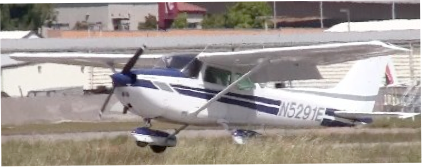

The other day I was on the tarmac at Gillespie watching planes take-off and land. In my unscientific observation, I estimate at least half the planes (mostly, students training), were landing at least 20-40% too fast. How could I tell? Well, they floated (seemingly) forever. You see, Clyde Cessna and Bill Piper designed these planes to fly. And that’s just what they’ll do; fly… and fly… and fly… until they’re done flying.
One of many valuable things I learned from flying gliders is how important precise speed control is --- in all phases of flight --- but particularly during landing. These speeds are calculated for the glider before you even launch (factoring in gross weight, wind and density altitude). Then, as PIC, it’s your job to nail those speeds in the air. Once I got a little slow (and a little low) on final in the Schweizer and we just kind of ‘hung’ there. When you’re slower than best L/D, induced drag increases exponentially (region of reversed command). In a powered plane, you would add power, lower the nose and re-group (or go around). In a glider, there are fewer options. You quickly learn to not let that happen again.
My soaring instructor described to me how he and his brother had a landing contest in gliders --- landing the width (not the length) of the landing area --- and precise control of airspeed is what made the difference between a 100’ rollout or landing long and crashing into the gliders ahead of them. As you increase your airspeed above that ultimate ‘over the fence’ final approach speed, the amount of runway you eat up floating increases by the square of the percentage you are over optimum airspeed! If you’re supposed to be at 55 KIAS on final in a Cessna 172SP, and you’re actually at 65 knots (20% higher), that’s going to increase your landing distance 44%. Float on. Fly that same final approach at 75 knots and you just increased your landing distance by 85%. Float on, float on.
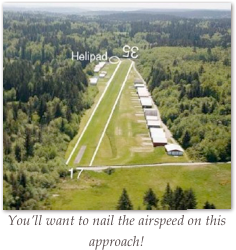
Keep in mind, most of the numbers in the POH (printed when the aircraft was new and flown by a test pilot), are based on a certain gross weight (usually maximum gross weight) and certain flight conditions. So you really need to determine what those airspeeds are --- and the power required to achieve them --- in your airplane, today; at the current weight, CG and atmospheric conditions.
YOUR MILEAGE MAY VARY
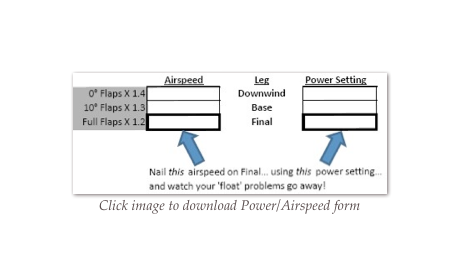
When tweaking your airspeed and power settings, keep these factors in mind:
Runway condition – a wet or icy surface or downslope will extend your ground roll; a non-paved surface or upslope will reduce your ground roll.
Wind – A headwind component will decrease your ground roll; a tail wind (downwind landing) will substantially increase your ground roll (up to 10% for each 2 knots), and a crosswind will make your rollout all the more exciting. Be sure to add at least half the wind gust to your approach airspeed (the ‘wife and kids’ factor).
Weight below MGWT – Rule of thumb is to decrease stall, L/D (glide) and approach speeds by ½ the percentage you are under MGWT. For example, if you’re 20% under maximum gross weight (such as flying a 172 solo with ½ fuel), decrease airspeeds by 10%.
Density Altitude – The reduced performance at high density altitude will require a higher true airspeed to sustain the aircraft throughout its operating parameters. A rule of thumb is to increase takeoff and landing rolls by 20% for each 1,000’ of density altitude (at 5,000’ DA, double your estimated sea-level runway requirements).
DIAL IT IN
Now that you have a better feel for power settings related to airspeeds, start fine-tuning your approaches and landings and see how well you can begin to put the airplane on a precise location on the runway for each landing. Set the standard high; if you calculated a final approach speed of 61 knots, fight for that! Don’t allow airspeed to vary between 58 and 64, etc. --- 61 is 61 --- period. If you don’t feel comfortable fine-tuning this on your own, grab an instructor with a lot of short-field experience and have him or her show you the way!