

Among the many great services AOPA offers members is their TurboMedical program. (Click here) It is essentially a dress rehearsal for your actual medical exam. TurboMedical takes you through the questionnaire you must complete before your physical (either ahead of time; see MedXpress below, or in the doctor’s waiting room). Their system ‘red-flags’ anything you have noted that may be cause for concern. This gives you the chance to gather any additional documentation, ECG’s, X-rays or consultation reports you might need so that you can indeed waltz out of the doctor’s office with a fresh medical.
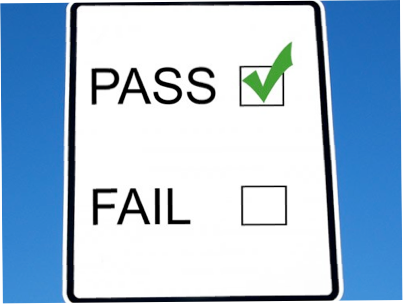
I’ve listed below the pertinent questions that appear on the 8500-8 form. Note that these forms are serialized, so it is not possible for your doctor to just rip up the form if you fail the medical and “pretend this exam never happened”. You will either Pass or Fail the exam (the third option being no certificate issued; deferred for further evaluation).
In addition to your answers to Medical History questions, the doctor will exam you in the following areas: Head, face, neck, nose, mouth and throat, ears, eyes, lungs and chest, heart, abdomen, upper and lower extremities, neurologic and general systemic. He’ll also note whether you pass/fail a conversational voice test at 6-feet, give you a vision test in both eyes and note whether you pass/fail a color vision test. Blood pressure and pulse is generally checked for all levels of certification; urinalysis, ECG tests, etc. may or may not be conducted for 1st and 2nd class medical certification.
IT’S NOT OVER ‘TIL IT’S OVER
Although you may leave the AME’s office with a new medical, your doctor still has to submit your 8500-8 to the blue haired gals in Oklahoma City for final review. And there is a
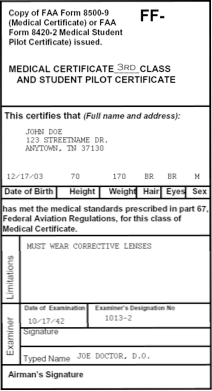
And even after you have a fresh medical in your hot little hands, you’re not home free until the thing expires. Keep in mind Sec. 61.53; you may not act as PIC if you “know of any medical condition that would make you unable to meet the requirements for the medical certificate”. In other words, if you get a new medical certificate on Monday, and then begin to experience atrial fibrillation on Tuesday, you can’t serve as PIC --- it’s just as though you had an exam that day and failed it. 61.53 goes on to discuss taking medicine or receiving treatments that make you unable to pass that same medical certification you now have. Be sure to review the implications of any medicine --- prescription or non-prescription --- that you may be taking, and how it might affect your ability to serve as PIC in an airplane (and yes, AOPA has an app for that; check into their Medical Database at aopa.org)
OPENING A CAN OF WORMS
Part 67 covers Medical Standards and Certifications. Section 67.413 discusses the requirement that you furnish any information regarding your medical history that they request. If you hedge (or outright lie) on your application regarding a medical condition that you used to have, but is now no longer a factor, they may ask you to provide medical records supporting that. Or they may request that you authorize your doctor, clinic or hospital to provide those records to them. If for some reason those records don’t support what you originally stated on your medical application, you have now created a huge problem for yourself. Not only might your medical be denied, but you could also be fined (possibly imprisoned), and your pilot license may also be revoked. This is serious stuff, and you should discuss anything that might possibly be an issue with your AME.
BUT I PLAY A DOCTOR ON TV

BE AN ACTIVE PARTICIPANT IN YOUR OWN HEALTH
Flying airplanes requires us to stay current on regulations. We need recent flight time to carry passengers during the day and then some more currency to fly them at night. We need biennial flight reviews and we need to keep our charts and approach plates current and up to date. But in the process of all that, don’t neglect your own health issues. Eat right, get some exercise, stay fit and deal head-on with any medical issues that may crop up. Be proactive and educate yourself on what possible implications anything that occurs might have on your flying activities, and you should be able to fly safely for many, many years.
Additional links:
FAA MedXpress online 8500-8
Printable 8500-8 form:
http://www.aopa.org/members/files/medical/8500-8.pdf
NOTICE: Any person that knowingly falsifies, conceals or covers up by any trick, scheme, or device a material fact, or who makes any false, fictitious or fraudulent statements or representations… may be fined up to $250,000 or imprisoned not more than 5 years, or both. (18 U.S. Code Secs. 1001; 3571).
National Driver Register - Sec. 67.7 authorizes the FAA to access your driving records from the DMV. Don’t neglect to mention any DUI’s you received --- they will be a deal-breaker in getting medical certification.
The Questions:
✓Has your FAA Airman Medical Certificate ever been denied, suspended or revoked
✓Do you currently use any medication (Prescription or Nonprescription)? (If yes, list which ones)
✓Do you ever use near vision contact lens(es) while flying?
✓Frequent or severe headaches
✓Dizziness or fainting spell
✓Unconsciousness for any reason
✓Eye or vision trouble except glasses
✓Hay fever or allergy
✓Asthma or lung disease
✓Heart or vascular trouble
✓High or low blood pressure
✓Stomach, liver, or intestinal trouble
✓Kidney stone or blood in urine
✓Diabetes
✓Neurological disorders; epilepsy, seizures, stroke, paralysis, etc.
✓Mental disorders of any sort; depression, anxiety, etc.
✓Substance dependence or failed a drug test ever; or substance abuse or use of illegal substance in the last 2 years.
✓Alcohol dependence or abuse
✓Suicide attempt
✓Motion sickness requiring medication
✓Military medical discharge
✓Medical rejection by military service
✓Rejection for life or health insurance
✓Admission to hospital
✓Other illness, disability, or surgery
✓Medical disability benefits
✓History of any arrest(s) and/or conviction(s) involving driving while intoxicated, impaired or under the influence of alcohol or a drug… an offense which resulted in the denial, suspension, cancellation, or revocation of driving privileges… attendance at an educational or a rehabilitation program.
✓ History of nontraffic conviction(s) (misdemeanors or felonies).
✓ Visits to health professionals within last 3 Years.
✓ Name/Address/type of health professional consulted and reason.
© 2012 Garry Wing