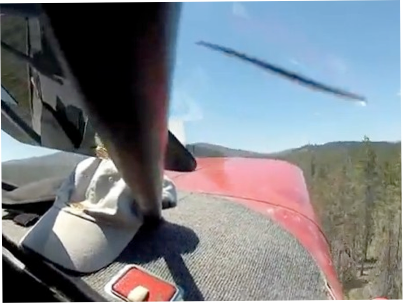

By now you’ve probably seen the horrific in-cockpit video of the ’47 Stinson trying to takeoff with all the seats filled from an Idaho dirt strip on a hot June afternoon. Click here to view the YouTube video.
The video has been viewed over a million times and created a lot of on-line chatter and second guessing. It’s hard to say what you would do in a similar situation when it’s all happening in real-time and rather quickly (the crash happens in less than 3-minutes). With the advantage of 20/20 hindsight we can use this example to focus on a couple key points that might have broken the accident chain.
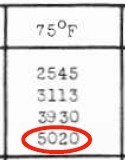
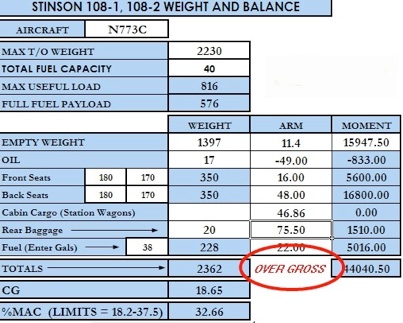
I did a little research on-line and was able to find the original POH and weight and balance calculations for N773C. I was also able to find the nearby METAR for that day and time, and of course the departure airport information at U63. Here are some observations.
UNDERSTAND WHAT DENSITY ALTITUDE IS
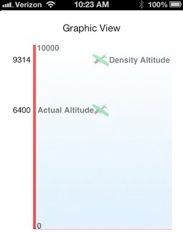
We learned about DA as Student Pilots, but do you really understand its implications? The textbook definition is “pressure altitude corrected for nonstandard temperature variations”. (FAA Safety pamphlet - click here to download PDF)
Rote memorization of that definition will score you one point on the knowledge test, but more important is the practical implication. Field elevation, temperature and humidity (to a lesser degree) all contribute to density altitude. The air is thinner (less dense) when DA increases, so there are fewer air molecules flowing over the control surfaces (resulting in reduced lift) and fewer molecules going into the engine air intake. Density altitude affects airplane performance. Normally aspirated (non-turbocharged) engines will develop less horsepower than they would at sea level, on a "standard” temperature day.

MAKE WEIGHT & BALANCE EASY
I dreaded doing those WT X ARM = MOMENT calculations before every friggin’ flight lesson. I knew it was important, but it was dry, boring stuff --- I wanted to go fly an airplane, not solve a math problem! So here’s how I approach it with the airplanes I fly on a regular basis. I ‘ran the numbers’ for the way I normally fly. For example, in the Warrior trainers, I calculated weight & balance for a 200-lb. student, full fuel, a small amount of baggage and myself. We are comfortably within the weight and CG limits in that scenario, so I never calculate that again (that’s the good news).
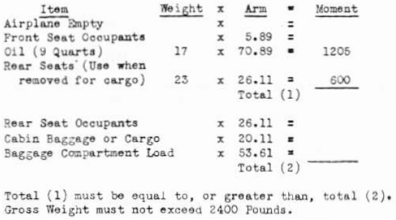
In the Skylane, it’s virtually impossible to get outside the CG range; the limiting factor in that plane is gross weight. I know how much I weigh, and I know how much full fuel weighs, so the calculation I have written down on my checklist is “Me + full fuel + 383 lbs.” As long as my passengers & baggage do not exceed 383 lbs., no need to run the numbers. If the passengers, baggage or cargo I’ll be carrying (with full fuel) exceeds 383 lbs., somethin’s gotta give, plain and simple. Burn off or offload fuel (remember to recalculate fuel needed for the trip!), and/or slim down the passenger manifest.
By the way, one of the dirty little secrets about small airplanes is that you can never fill all the seats (with adults) and then fly with full fuel. This is true with a Cessna 172, a Bonanza, a Citation and certainly with a Stinson. The seats were put in by the marketing department to sell more airplanes. As you know, airplanes are not like station wagons. Everything in an airplane is a tradeoff between weight and performance. If they built a plane like a tank (or even like a passenger car), it would be so heavy that it would never get off the ground. The Warrior POH even starts the Weight and Balance section by warning the plane “cannot be flown with the maximum number of adult passengers, full fuel tanks and maximum baggage”. When I first watched the Stinson crash video, that was one of the first things I noticed --- “hey, they’re taking off with 4 adults in that airplane” --- that can’t be good. Strike 2.
ALWAYS, ALWAYS HAVE A ‘PLAN B’
Flying airplanes is a series of endless decisions and judgments. One of the enjoyable aspects to me is that no two flights are exactly the same. There is always something new and different to learn or to deal with. In addition to the density altitude and weight and balance considerations I’ve presented, I would also have briefed the mission. Perhaps they did this before the video began to roll; I have no idea, but it didn’t look like the pilot ever switched from his original plan to “get this damn plane in the air”.
THE 70/50 RULE
There’s a general rule of thumb that on takeoff you should obtain 70% of your required airspeed by the time you’ve eaten up 50% of the available runway. If you don’t, then you pull power to idle and stop in the runway remaining. The Stinson 108 POH recommends a takeoff speed of 80MPH. So I wouldn’t put that thing in the air unless I saw 60MPH on its 65-year old airspeed indicator by the time I was half-way down the runway. An important component of this rule-of-thumb is that you’re not delusional about where that half-way point is located. Either walk or drive the runway, and set a flag or marker, or choose a well-defined object as your “go or no-go” point. Then stick to it.
In the video, the first minute or so looks fairly ‘normal’. (Someone observed that he had mixture full rich, instead of leaning it for a 9,300’ density altitude, but I was not able to see that). But at 1:00 into the video, you see that after being airborne for a few feet, the plane settles (or mushes) back to the ground. He had a false sense of security in ground effect, but as soon as he tried to climb out of it, the plane settled back to the runway. That would have been a giant red flag to me. Never leave ground effect at less than Vx; it’s just not going to work. Pull power, stop the plane and let’s regroup. Maybe take some fuel (or a passenger) out of the plane? Scrub the flight for this afternoon; let’s try it again tomorrow morning when the temperature was 24-degrees lower, and the density altitude was 1,500’ lower.
This low-time pilot may not have known this, but there is also going to be a difference in the air over the runway and the terrain that lies beyond the runway. The heat of the sun unevenly warms the earth. (That’s what creates our weather!) Dark terrain (dirt, pavement, parking lots, etc.) absorbs more heat and produces thermals, which are rising columns of air. The thing to know about thermals is that for every parcel of rising air, there’s a corresponding parcel(s) of descending area. They may not be the same in size or energy, but they do offset one another. If I were landing at U63, I probably would have noticed the dark dirt of the airstrip, followed by the lush green tree area beyond the runway. Although I knew the video was going to end in a crash, the first time I saw it, I had no idea what the terrain was like. When I saw the airplane unable to climb away from the dirt terrain --- and then approach a bunch of trees, I immediately thought, “he’s about to lose whatever lift he’s getting when he gets over those trees”. I think I read somewhere that the pilot commented “he got into a downdraft” and that’s what took him into the trees. Well, kind of sort of. Don’t blame it on the air. As a pilot you should know better.
SO, WHAT’S THE ANSWER?
I don’t have a pat answer on all that you see in the video, but here are some top-of-mind thoughts:
-
•Calculate density altitude whenever you’re more than 1,000’ or so above sea level, and/or it’s a really hot, humid day. Be sure you understand how your airplane actually performs at that altitude before you attempt to land or takeoff at that DA.
-
•Calculate weight and balance for any flight scenario in which you have not previously calculated it. Whenever you embark on a flight that is not the same as the flight you’ve done dozens of times before (unusual weather, airport conditions, passenger or fuel situation, different airplane configuration or performance), spend 5-minutes to actually see how it’s going to affect the performance.
-
•Take the numbers you see in the POH with a grain of salt. When I downloaded the Stinson POH, I was surprised to see it was typed on a regular old typewriter, and some of the diagrams were hand drawn --- in 1947! Would you trust your life to that? When I learned to fly gliders, I was taught to take the manufacturer’s stated glide ratio (such as 30:1), and immediately cut it in half (15:1). 50% is a pretty good safety margin.
-
•Get some more training if you don’t feel comfortable with some aspect of aviation. Yes, I’m an instructor, and this may seem self-serving, but hell, I don’t care if you fly with someone else, just call someone! If you aren’t comfortable with crosswinds, the effect of density altitude, an aft or forward CG, stalls, spins, navigation, mountain flying, emergency procedures, whatever --- get some instruction and practice. Who knows, you might even enjoy it and actually learn something!
Click here to view the NTSB preliminary report.
© 2012 Garry Wing