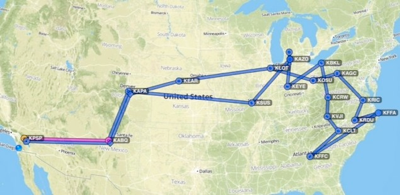


On August 9th, I embarked on a 6,000-mile, 20-state, 39-day “long” cross-country in my Cessna Skylane. Inspired by a friend who had flown his Piper Arrow to Alaska over a 4-week period, (but with no interest in going to Alaska); I began planning several months ago to attend five NASCAR races on consecutive weekends in August and September (Michigan, Bristol, Atlanta, Richmond and Chicago).
I locked-in race tickets, hotels and rental cars for all five weekends, but left the weekday planning rather open; choosing to shoot off for some short-hop side-trips on the days between weekend races, based on prevailing weather and whatever seemed to interest me. I made some observations throughout the adventure, but no major revelations or epiphanies occurred, except for the one at the conclusion of the trip (revealed at the end of this article). A couple big-picture overall thoughts:
1. You can never plan too much for a major trip like this;
2. Be flexible and open-minded in accepting things you did not plan for.
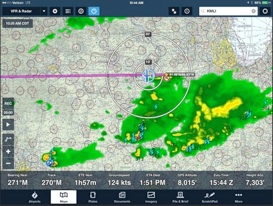
I never had to divert due to weather, except for the trip home (more on that, later). I flew about 55-hours over the 39-days; about 7-hours of that in solid IMC. I flew every leg on an IFR flight plan, except for three short hops with VFR flight-following. I encountered the TFR in St. Louis for the Michael Brown shooting, a temporary control tower in Chicago (KLOT), erected just for the NASCAR weekend, and an assortment of seemingly endless route clearances and amendments.
The advantages of filing IFR were that I didn’t have to pay close attention to TFR’s or Restricted, Bravo, Charlie or MOA airspace, and I didn’t have to ‘think’ too much about routing. ForeFlight offered suggestions, ATC told me what to expect, I got a clearance and I flew what they told me. The most challenging part of the IFR flights several times was figuring out how to actually get my clearance, particularly at non-towered airports. Sometimes the A/FD would reveal a secret phone number or frequency; generally an RCO available on the field (but only at certain places). Sometimes an approach plate or Airport Diagram would give a clearance frequency, but mostly I just asked the locals after landing; “How do I pick up my IFR clearance when I leave here?”
BEEN THERE, DONE THAT; BARELY REMEMBER ANY OF IT
Many of the cities I visited along the way were places where I once lived, and also flew out of in my early Private Pilot days:

> St. Louis, MO; where one of the only good things about my employer in the mid-80’s was they had a barter arrangement with a local FBO, enabling me to rent airplanes at no cost.
> Charleston, WV where they literally shaved off the top of a mountain to construct Yeager International Airport.
> And Raleigh, NC and Richmond, VA; where with my old friend and former business partner Dan O’Toole, we created the first broadcast consultancy that used private aircraft (a Cessna 172) to fly directly to client locations (that lasted about 3-months once we ran the numbers on what it cost, vs. flying Southwest).
It had been anywhere from 25-40 years since I’d last flown in some of these cities; the airports and the cities around them had changed greatly. I don’t know what I was expecting, but I may as well have been in Anytown, USA in any case, as it was all mostly unfamiliar to me decades later. The old adage, “you can’t go home again” may indeed be true. I leave a city and over the next 30-years it continues to change and evolve; go figure.
Here are some random thoughts and observations gleaned from my travel adventure. I’ve divided my notes into three sections; Cross-Country Flying, IFR Flying, and General Travel Tips.
CROSS-COUNTRY FLYING
> When planning a long cross-country excursion, break the trip into multiple, more manageable segments. I had a ‘big-picture’ overview of where I was going, but I really only focused on the next day of flying, being sure to review weather, airport information, procedures and approaches, etc. There are many choices and options when you’re outbound and you’ve given yourself a buffer of a day or so to get from here to there. But when you’re inbound, on the return legs, time constraints, airplane maintenance, fatigue and scheduling issues are things you’ll have to contend with.
> Perform a detailed pre-flight inspection each day. My airplane was outside every night, and was often times moved by line personnel (never use the parking brake when parking at an FBO). While I found no damage, I sure did look closely to be sure. I always visually inspected the fuel quantity and re-seated each fuel cap myself. I sumped the tanks after taking on fuel, particularly in a city where there had been any rain (and there were many times it rained). I called the FBO each morning to request a fuel top-off (preferring to do it on the morning of departure, rather than a day or two prior).
> Take the long way home. After pre-flight, walk the longest way possible around the airplane before getting in --- check for chocks, secure baggage compartment and doors, fuel caps, leaks or anything that doesn’t look normal.
> Learn the hand signals that line crews use. I reviewed this video before the trip: http://youtu.be/9d8EQ1mMbFU
> Verify the fuel truck says 100LL. Beware of the wacky places they try to clip the static lead. Carry extra $5 bills to tip the linemen. Don't let others rush you; many FBO’s at the larger airports come out with a golf cart (or your rental car) to take you to the office. I always declined and said I had a few things to do to button down the airplane. I created a short “tie-down” checklist in my iPhone (yoke lock, close air vents, pitot tube cover, etc.)
> If you’re using ForeFlight, download all Airport Diagrams, Takeoff Minimums, Hot Spots, approaches and DP’s for each airport (it's only temporary memory space). Mark up the Airport Diagram with the FBO Location, so after you land, you know where you’re going.

> Estimate and write down your anticipated fuel required at each stop. This became a little game I would play to A) Verify they had indeed filled the airplane, B) Verify the fuel consumption I had estimated was somewhat accurate, and C) Verify that they weren’t overcharging me or mistakenly giving me somebody else’s fuel bill (it happened once). One time the lineman’s idea of “top-off” was to stop about three-quarters of an inch from the top. With the huge, flat fuel tanks (42-gallons each) on a Cessna 182, that’s about 6-8 gallons less than full. This was the morning of a short one-hour hop to the next city, so no big deal.
> Plan, but be flexible enough to deviate from the plan. Go with the flow. Traveling with a mini-cooler with re-freezeable ice bags seemed like a good idea, but I abandoned it after about the third leg. While many hotels have in-room refrigerators, most do not have a freezer compartment. Most of my flights were less than 3-hours, so the requirement for chilled food items was not as great as I had anticipated, especially as most flights occurred mid-morning, between breakfast and lunch.
IFR FLYING TIPS
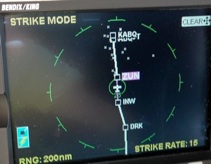
> I copied so many clearances with such intricate routing, that the first time I heard “Cleared as filed”, it surprised me. I had nothing to write down under the “R” in my CRAFT outline! This happened a couple of times in the vast wide-open spaces in the Midwest; in congested airspace like Atlanta, Chicago, Denver, Charlotte and Pittsburgh, you’re going to get a long route clearance, so be ready for it.
> Verify and confirm anything that’s not clear. One clearance I got did not include a departure frequency, so I asked for it. The Hugo Two DP clearance I got at Charlotte did not specify a transition, so I asked to verify (neither ForeFlight nor my KLN-97 would allow selection of that DP without choosing a transition). ATC said: "You're going to get radar vectors". OK, well that makes sense now that you told me, but you need to tell me. Essentially, the DP was to just "fly runway heading".
> If you have to divert, try to select a Class-C airport. These larger airports almost always have: control towers, radar, long runways, multiple approaches, emergency equipment, and available services such as fuel, aircraft repair facilities, hotels, rental cars, taxis, restaurants, etc.
GENERAL TRAVEL TIPS
> Bring a printed or digital copy (in your phone or iPad) of all hotel and car rental reservations. I also kept a log in the iCloud of each reservation, just to keep straight whether I had a car or needed a car in a particular city, etc. I began this trip thinking I could do it ‘paperless’, but had to abandon that plan when I was wrongly assessed a $92 re-fueling charge by Avis and was not able to provide a paper receipt from the gas station(they wouldn’t accept a screenshot from my B of A banking app of the Visa charge). I was eventually able to secure a POS print-out from the accounting department of Meijer and get them to reverse the charge, but arguing with car rental companies on the phone isn’t how I wanted to spend my time during my travel adventure!

> The value of a $130 hotel room is much greater than just $50 more than an $80 hotel room. What I’m saying is that the quality of hotels is not directly proportional to the rate. Once you cross the $120-130 threshold, you’re in Hilton, Hyatt and Marriott territory. Back in the late 80’s when they were first building them, I stayed in LaQuinta’s nearly every week. Now, they are old, dated and worn-out (you can’t go home again). I decided that life was too short to stay in lousy hotels (except in Bristol, VA, for the NASCAR race, where I had no choice and had to stay in the dumpy Baymont Inn). There were probably only three hotels I stayed in --- Hyatt Place (Atlanta, GA) and Sonesta Suites (Columbus, OH and Chicago, IL) --- that were even close to the caliber, cleanliness and quality comparable to what you would enjoy in your own home.
> Drive around the hotel when you first arrive and figure out which side of the building and which floor you want to be on. This became a little game with me, similar to finding the best deal on a rental car. Many of these hotels are built near highways, and if you’re not pro-active about selecting your room, you’re going to be awake all night listening to 18-wheelers roll over every expansion joint on I-94 (like I did the first night in Kalamazoo). I was also adamant about only staying in smoke-free hotels. Restricting smoking to certain floors still wouldn’t eliminate the likelihood of sleeping on bed linens that reeked of cigarette smoke. That’s just me, but as I get older (and crankier) I have less and less tolerance for the things that annoy and irritate me.


> In these multi-day whirlwind excursions, as you check-in to each new hotel, type the room number into a note in your smartphone. As the key cards don’t have room numbers on them, they’ll all begin to fade together fairly quickly. Remembering what city you are in is generally possible; remembering what city you were in previously, or your current hotel room number is next to impossible.

> Things you leave in the airplane do you no good (rain jacket, running shoes, sunscreen, etc.). On the flip side, you can never pack too lightly. I’m pretty good about bringing only essentials, and not lugging around a bunch of stuff I don’t need (Rick Steves says when packing, you shouldn’t ask yourself “will I ever use this?”, but rather, “can I live without this?”). I brought along my airplane’s trickle charger, in case the airplane was ever hangared for a night, I could ‘top-off’ the battery. I never did hangar the plane, and no real need for trickle-charging when I was flying every day or two.

SO, WHAT HAVE WE LEARNED?
As mentioned in the beginning, there was no bold discovery or revelation gleaned from this trip. I wasn’t expecting any Jack Kerouac on-the-road moments. The only thing even remotely insightful was what occurred when the trip was complete and I was home. And that is that despite all the good times, friends visited, NASCAR races attended, old airports re-visited and sights seen, I was just really, really, really glad to be home.
-
Garry’s Travelogue (City of landing)
-
ALBUQUERQUE, NM
DENVER, CO -
ST. LOUIS, MO
KALAMAZOO, MI -
GRAND RAPIDS, MI
INDIANAPOLIS, IN
CLEVELAND, OH
CHARLESTON, WV -
BRISTOL, VA
CHARLOTTE, NC
ATLANTA, GA
KITTY HAWK, NC
RALEIGH, NC
RICHMOND, VA
PITTSBURGH, PA
COLUMBUS, OH
CHICAGO, IL
KEARNEY, NE
DENVER, CO
ALBUQUERQUE, NM -
PALM SPRINGS, CA
-
The ‘working title’ throughout the many months of planning for this trip was my ‘Summer of George’. If you’re a Seinfeld fan, then you get it.
‘SUMMER OF GEORGE’ - BY THE NUMBERS
•5,703 nautical miles flown
•39 days
•20 states flown through
•19 different hotels
•18 different airports
•12 rental cars
• 7 Aviation museums visited (Denver, Kalamazoo, Charlotte, Atlanta, Kitty Hawk, Richmond, Washington, DC)
• 5 Greek meals of varying quality/authenticity
• 3 State Capitols toured (Raleigh, Richmond & Columbus)
• 2 Presidential museums visited (Ford and Carter)
•Many, many - Micro-breweries, ale & road houses visited and portions of salmon consumed.
- - - - - - - - - - - - - - - - - - - - - - - - - - - - - -
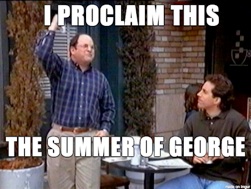
Meanwhile, instead of living a very active lifestyle as he had planned, George becomes incredibly lazy. He never changes out of his pajamas, and feels too weak to even come to Jerry's apartment, asking Jerry, Elaine, and Kramer to instead visit him or talking to Jerry on the phone to know what's going on over at his apartment.