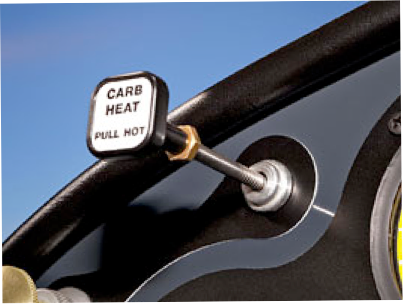

Every month there are a couple general aviation accidents attributed to carburetor icing. There were 212 accidents and 13 fatalities caused by carburetor icing between 1998 and 2007.

To prevent carburetor icing, the pilot should:
• Assure the proper functionality of the carburetor heat during the ground check (before takeoff).
• Use carburetor heat on approach and descent when operating at low power settings, or in conditions where carburetor icing is probable.
To recognize carburetor icing, the warning signs are:
• A drop in rpm in fixed pitch propeller airplanes.
• A drop in manifold pressure in constant speed propeller airplanes.
• In both types, usually there will be a roughness in engine operation.
You should respond to carburetor icing by applying full carburetor heat immediately. The engine may run rough initially for a short time while ice melts. If you turn off carb heat too soon, you may have only partially melted what ice there was in the carburetor, allowing it to re-form again.
TELL ME MORE, MR. SCIENCE
Here’s how you get carb ice. As the fuel/air mixture passes through the venturi (hourglass shaped neck), the air portion is compressed (fuel, being a liquid, is not compressed). This increased pressure inside the venturi creates a corresponding increase in temperature. But when the gaseous mixture exits the narrow part of the venturi, there is no more compression --- in fact it expands --- resulting in a temperature drop. The molecules spread out and the mixture cools.

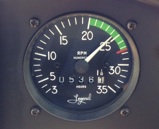
If you’re used to flying Piper Cherokees (Warriors, Archers, etc.) from the ‘70’s and ‘80’s, you may be accustomed to never using carburetor heat. These engines have their carburetors mounted at the bottom of the engine, close to the oil pan, containing hot engine oil. This keeps the temperature in the carburetor higher, and reduces (but does not eliminate) the tendency to produce carb ice. You’ve probably noticed the green arc on the tachometer of these airplanes extends all the way down to idle speed, such as 500 or 600 RPM.
THE WARNING SIGNS
If you find you have to nudge the throttle forward every couple minutes just to maintain the same RPM setting, that is a sign in a fixed-pitch prop airplane that you might have carb ice. In constant-speed (carbureted) airplanes, you won’t see a difference on the tach, as the prop blades change pitch to maintain the desired RPM. You will instead notice falling manifold pressure.
In either case, at the first sign of carb ice, you should turn carb heat on. Although it is a variable control, similar to a throttle or mixture control, you only want it to be all on or all off. There is no purpose in ever using partial carb heat. This might melt ice crystals that normally would have flowed through the carburetor and then refreeze as carb ice.
In most airplanes, the carb heat knob or lever operates a door that ports warm air being ducted from around the muffler, to the air inlet of the engine, bypassing the traditional filtered air intake. You either want the door opened and providing heated air, or closed (carb heat off). The cabin heater in most light airplanes works the same way, porting warm air from a baffle around the muffler into the cockpit.
Keep in mind when you have carb heat on, the warmer air going into the engine is less dense than the outside air, so you should see a drop in RPM whenever carb heat comes on (that’s how we check that it’s working in the runup area; looking for a drop in RPM). This less-dense warm air results in a richer fuel-to-air mixture, producing that RPM drop. If you are going to have carb heat on for more than a few minutes at altitude, you should lean the mixture for maximum RPM (but not when using carb heat in the traffic pattern.).
FIRST IN, LAST OUT
When the engine is running at high power settings, the fuel/air flow is traveling at very fast speeds, with less time for water vapor to change to ice. Most engines aren’t prone to carb ice at full power or high cruise settings, although with the right atmospheric conditions, carb ice is possible at any power setting.
When power is reduced from full throttle the likelihood of carb ice increases. Remember, application of carb heat is porting warm air into the carburetor. When you have throttle at idle, there is very little fuel and air going to the engine; just enough to keep it idling at 600 or so RPM. This is why you always want to apply carb heat first --- when you still have a fair amount of power --- then reduce engine power. If you had even a small amount of carb ice, and you reduced power first, then turned on carb heat, there is now not enough warm air going through the carburetor to clear that ice or prevent further buildup. When you anticipate reducing power below the green arc on the tachometer, turn on carb heat 10-seconds or so ahead of time, then reduce power.
For more information, see:
Handling In-Flight Emergencies, by Jerry A. Eichenberger
© Garry Wing 2015