

You know when I throw three acronyms at you in the article title, this must have something to do with the FAA; the government sure does love those TLA’s (Three-Letter Acronyms).
Many FAA knowledge test questions are out of date (lots of NDB, not much GPS), overly complex (requiring multiple interpolations to calculate a two-knot difference in wind) or irrelevant (how many satellites in the GPS constellation). Some of these questions were disconnected from “real” skills and knowledge required for safe operation in the national airspace.
AIRMEN CERTIFICATION STANDARDS
The ACS is an “enhanced” version of the PTS. It adds task-specific knowledge and risk management elements to each PTS Area of Operation and Task. It results in a holistic, integrated presentation of specific knowledge, skills, and risk management element and performance metrics.
BREAKING THE CODE
The ACS does not change the check ride, and it does not make the check ride any longer than it takes to conduct a PTS check ride today. It does replace all those cryptic, generic LSC (Learning Statement Codes) with a whole new bunch of cryptic, yet specific, codes. One example would be:
-
PA.V.A.K6
-
PA = Private Airplane
-
V = Area of Operation V (Five)
-
A = Task (Steep Turns)
-
K6 - Element (Overbanking Tendency).
Is your head ready to explode yet?
A BETTER IDEA
One quick rant here, then back to the ACS. Rather than scrap the old Learning Codes, and devise more specific codes, why don’t they just tell the applicant which question(s) he/she missed on the knowledge test --- and what the correct answer is? I can’t tell you how many times I’ve reviewed an applicant’s incorrect Knowledge Test answers with them prior to their check ride --- sometimes a test they took months and months ago --- and they have no recollection of the question, let alone the answer choices, much less which of those answers they selected! We sit there and have a random conversation about the general topic for a few minutes, and then call it a day.
They may have missed a question because they’re confusing overbanking tendency with left-turning tendency, they misread the question or answers, or they know the material, but are just not very good at taking tests. We’ll never know. Thanks, FAA. You may say the knowledge tests are about testing, not learning, but then why do we have to follow-up with the student on questions they’ve missed? That would seem to me to be a learning / teachable moment. I don’t understand why the FAA hasn’t learned more about how people learn, and the importance of specific feedback in that process. Can you imagine failing a task on the check ride, but the examiner not telling you specifically why you failed?
In their own Aviation Instructor’s Handbook the FAA suggests that assessment (testing) of students should be constructive (provide “positive guidance”) and specific (“students cannot act on recommendations unless they know specifically what the recommendations are”… “students should have no doubt about what they did poorly, and most importantly, specifically how they can improve”). The rules committee requested that the FAA return the bank of knowledge questions to the public domain, but the FAA rejected that advice. It boggles the mind what they’re thinking.
TAKE A SNEAK PEEK
Here’s a side by side comparison of one task from the Private Pilot check ride, Steep Turns. First, here is the way this task currently appears in the Private Pilot PTS:
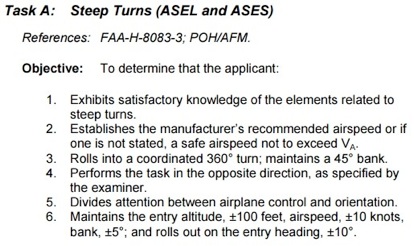
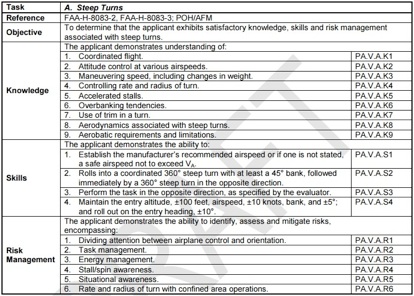
An overview of the FAA’s new ACS (PDF) can be found by clicking here.
And finally, click here to access a general portal for Training & Testing resources on the faa.gov site.
© Garry Wing 2015