



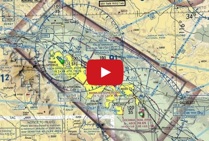
Many students and a few pilots are needlessly sheepish about flying in or through TRSA airspace (pronounced "Tersa"). There are 30 TRSA's in the U.S., but only one on the West Coast, surrounding the Class Delta airspace of KPSP/Palm Springs International Airport. (Non-towered airports KUDD/Bermuda Dunes and KTRM/Cochran Regional lay under the TRSA).


The floor and ceiling of TRSA airspace is indicated in the same manner as it is for Class B and C airspace, however it's printed in black (not blue or magenta). For the Palm Springs TRSA, the ceiling is 10,000' MSL everywhere, but the floor varies, from the surface within the PSP Class Delta, to a piece beginning at 2,000' MSL just north of I-10 (between PSP and UDD), and 3,500' MSL elsewhere.
A SHORT HISTORY LESSON
Part of the Airport Radar Service Area (ARSA) program was to eventually replace all TRSAs. However, the ARSA requirements became relatively stringent and it was subsequently decided that TRSAs would have to meet ARSA criteria before they would be converted. TRSAs do not fit into any of the U.S. airspace classes; therefore, they will continue to be non-Part 71 airspace areas where participating pilots can receive additional radar services which have been redefined as TRSA Service.
HOW IT ALL WORKS
The purpose of the radar service in a TRSA is to provide separation between all IFR operations and participating VFR aircraft. The primary airport within the TRSA becomes Class D airspace. The remaining portion of the TRSA overlies other controlled airspace, which is normally Class E airspace. Participation in TRSA services is voluntary; however, pilots operating under VFR are encouraged to contact the radar approach control and take advantage of TRSA service.
Let's take a quick look at the practical implications of this, regarding the Palm Springs TRSA.
ARRIVING PALM SPRINGS
First, if you're on an IFR flight plan, you don't need to be aware of the TRSA; you'll already be on a discrete squawk code and communicating with SoCal (Approach/Departure TRACON), with the possible exception of 'radar contact lost' while you fly through the Banning Pass.
For VFR flights on Flight Following, it's a similar situation; you'll be handed off to the Palm Springs sector (135.275 at the time of this writing), then eventually turned over to tower before you enter the KPSP Class Delta airspace.
For arriving VFR flights that aren't talking to anyone (squawking '1200'), you should contact SoCal before entering the TRSA; give them your location and destination, and give them the current hourly ATIS identifier at KPSP. They'll provide you a squawk code; enter it in your Transponder but 'IDENT' only if they ask you to. They'll come back and verify your position: “Cessna 53-Golf, radar contact 1-3 miles West of Palm Springs airport, altitude 4,200...” You can simply reply, “53-Gulf, check” if you believe they have ID'd your airplane correctly, or clear up any confusion if they have not (it's happened a to me a couple times).


Sometimes, when SoCal gets really busy (generally mid to late morning), they may forget you, so remember, you can't enter the KPSP Class-D without establishing radio contact (with the tower; talking to SoCal doesn't count), so be sure to stay above 3,000' (the ceiling of the Class Delta) until you've established contact with tower. Also, if you're restricted above 3,500', you must tell tower that on your initial call-up. You're still restricted until you're not. A previous heading or altitude clearance doesn't get canceled when you're handed off to another controller or facility! You want to hear "descend unrestricted" or "cancel altitude restriction".
DEPARTING PALM SPRINGS
This is a little different than simply leaving any other airport; they want to know what airport you're going to. Even though there is a Clearance Delivery frequency at KPSP (128.35), I think that other than during the week of Aviation Expo, they never use it (under-staffed). ATIS almost always says “all departures, contact Ground Control on 121.9 for clearance”. So, call ground, tell them who you are, where you are on the field, where you're going and the current ATIS information letter. They'll give you a squawk code and departure frequency (135.275), which you must read back to them. In that transmission or the next, they will also give you your taxi clearance. Write it down, read it back, then figure it out (you do have the airport taxi diagram out, right?).
If you're confused or unsure of what to do or where to go, no worries... ask them! A couple years ago I toured the new control tower at Palm Springs, and asked the controllers on duty what pilots do that frustrates and annoys them most. They said, "pilots that don't ask for help". Whether they've given them some instruction or clearance for arrival or departure, and the pilot seems confused, or perhaps doesn't seem confused, but then apparently is, as they don’t do as instructed. The controllers said they are more than happy to help and guide pilots, but please don't act like you know what you're doing if you really don't. Ask for a progressive taxi or just admit, “my first time here, unfamiliar with the area, please give me vectors / call my base / tell me when to turn / where to go...”, etc.
If you're departing through the Banning Pass, they'll lose radar contact with you when you're behind the 11,000' San Jacinto mountain. They’ll normally tell you to "stay on that beacon code, and contact SoCal when you're West of Banning Airport on 134.0".
ARRIVING BERMUDA DUNES OR COCHRAN

At Cochran (KTRM; CTAF is 123.0), it’s also left-traffic for all runways, even though you'll see and hear pilots do all sorts of wacky arrivals and departures; right downwinds, right crosswinds, straight-ins, etc. Cochran airport sits below sea level (-115' MSL), so don't panic when you're on short-final and see the altimeter go below 0 for the first time! TPA at Cochran is 883' MSL (1,000' AGL), which you can round off to 900' MSL.
DEPARTING BERMUDA DUNES OR COCHRAN
No big trick to this. Do your normal departure from a non-towered airport; make your radio calls, look for traffic, etc. When you're 3 or miles from the airport and climbing, contact SoCal on 135.275 to get Flight Following to your destination, if you want. Remember, VFR operations in a TRSA are voluntary, so unless you're going to land at KPSP, you don't have to contact them, but I sure would advise it. There’s a lot of traffic east of Palm Springs airport, flying to or from the VOR, which is not on the field, but northeast of it, on the far side of I-10.
‘NEGATIVE TRSA’
Note you can decline TRSA services; simply say “Negative TRSA” on your call-up for a VFR departure at Palm Springs. They'll still give you a discrete squawk code for your operation in their Class Delta, but will not give you a Departure Frequency for SoCal. When you're outside the lateral bounds of the Class D, they'll give you a frequency change and tell you to squawk VFR (1200). That just means you no longer need to talk to them; whether you want to switch to Banning CTAF, or KUDD or KTRM if you're flying south, or monitor 121.5 is entirely up to you. Without Flight Following, which you have declined by stating “Negative TRSA”, there is no longer a need to talk to anyone (as long as you obviously remain outside any Class B, C or D airspace).
Now that you know some of the not-so-hidden secrets of transitioning into, out of and through a TRSA, get your feet wet and make the trek to one of the three airports in the Coachella Valley for a couple hours or a couple days. Feel free to email me any specific questions you may have on any of this, or if I got anything wrong.
ADDITIONAL REFERENCES
-
•FAA's Pilot's Handbook of Aeronautical Knowledge, pages 13-15 and 14-6
-
•AIM, section 3-5-6
-
•FAA's Aeronautical Chart User's Guide
-
•Monitor KPSP Tower/SoCal on liveatc.net
© Garry Wing 2016


