September 2016
GLIDE TIME AFTER ENGINE LOSS
In the highly unlikely event of an in-flight engine loss, you’ll remain airborne for about 2x your altitude (in thousands).
Example: at 4,000’ AGL, you’ll have about 8-minutes; at 10,000 AGL, about 20-minutes. This rule-of-thumb works fairly well in most 4-seat single-engine airplanes, assuming you fly the correct Best Glide airspeed for your gross weight, and stay coordinated and ‘clean’ (gear and flaps up).
August 2016
TOWER SWITCHES YOU TO GROUND
After landing, you should stay on Tower frequency until they switch you to Ground.
At Gillespie, after landing on RWY-27R, they often instruct you to either "cross 27-Left and contact Ground" or "hold short of 27-Left". In the case of the latter, you should stay on Tower frequency until they eventually cross you over 27-Left. Once crossed, then you switch to Ground.
It's a minor but essential point: cross the runway, then switch to Ground. And when you call Ground on the other side, tell them you're clear of 27-Left (the runway you just crossed), not 27-Right (the runway you earlier landed on). For more on all this, see the AIM: 4-3-20.
July 2016
NON-PRECISION ACCIDENT RATE
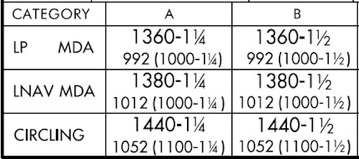
The accident rate of non-precision approaches is 5-times that of precision approaches, according to an Air Safety Foundation study.
The FAA recommended years ago that the “dive and drive” non-precision technique should be discontinued as they contribute to CFIT. Rather, they advocate a stabilized, continuous descent when flying non-precision approaches.
When selecting an approach to an airport in IMC, pick the one that gets you the lowest, while providing vertical navigation. Generally, that would be an LPV, ILS or LNAV/VNAV (assuming you have WAAS, I prefer the integrity/accuracy of LPV over ground-based ILS).
June 2016
Flaps down; Nose down.
As you bring the flaps down, you must lower the nose to maintain the same airspeed. The more the flaps come down, the more the nose must come down. It's simple aerodynamics, as the increased drag requires a pitch change to produce the same result.
But then, that's the whole point of flaps, right? They allow us to steepen the descent without picking up airspeed. The same is true if you slip the airplane. Anything other than coordinated flight is going to require you to lower the nose to produce the same airspeed.
May 2016
Divert to Class-C
If you're flying cross-country and need to divert for some (non-emergency) reason --- weather, you're getting tired, you have some anomaly with the airplane --- select a Class Charlie airport, whenever possible.
Class C airports always have radar, ATC (approach / departure / tower), multiple IAP's and lots o' services --- emergency support, airplane maintenance, rental cars, hotels, restaurants, FBO's, etc.
As an example, if I were flying back from Northern California and needed to divert in Central California, I would choose FAT (Fresno) in the valley, or MRY (Monterey) on the coast, before FCH (Chandler) or SNS (Salinas).
April 2016
“SWITCH TO MY FREQUENCY”
The controller is asking you to switch to another frequency (but continue to communicate with him; not another controller). There are no hard-and-fast rules (that would be too easy), but in general, in keeping with the 'read-back all clearances and instructions' paradigm, you would say: "7-Foxtrot-Lima; switching 121.7". Then, switch to that frequency and say, "7-Foxtrot-Lima up on 121.7" (note: no "with you").
You could just switch without saying anything, but unless the controller brought his crystal ball to work with him today, he can only guess whether you A.) heard him, B.) understood him, and, C.) have actually switched. So, just do it the way I've explained, and don't gum up the works by making the rest of us guess what you're doing.
March 2016
NO PARKING BRAKE
When you park an airplane at an FBO, whether for an hour or for multiple days, you shouldn't use the parking brake.
Rather, you should chock or tie-down the airplane. In the event the FBO needs to re-position the airplane, you will not want to have the parking brake applied.
Also consider your use of a parking brake when parking at non-ramp / transient locations. A stuck or broken cable or mechanism would then disable the aircraft and could leave you stranded at a remote airport. Use your best judgment.
February 2016
Fly Over the Towers
When flying over high-tension power lines, you should fly over the towers, not the wires themselves. There will be no wires higher than the tower (just make sure there are no towers higher than the one you're flying over). Don't rely on those yellow or orange balls they put on the wires themselves, as they may not be on the wire you're about to fly into.
January 2016
“FREQUENCY CHANGE” WHEN LEAVING AIRPORT
It's not required... so quit asking for it!
This is one of my (many) pet-peeves. When you're outside the lateral bounds or above the airport surface area (2,400' MSL at Gillespie), you don't need to request a frequency change.
AIM 4-3-2 (a) advises, "in the interest of reducing tower frequency congestion, pilots are reminded that it is not necessary to request permission to leave the tower frequency once outside of Class B, Class C or Class D surface areas". So there.
December 2015
Comply Upon Receipt
You should comply with a clearance or instruction from ATC upon receipt.
When they say "cleared for immediate takeoff", you should reach for the throttle and start moving the airplane toward the runway (then key the mic and read back the clearance).
When they say "turn base", you should begin to turn the airplane (then key the mic and read back the instruction). When they tell you to "go around", you should begin to go around... you get the idea. Aviate. Navigate. Communicate. Refer to AIM 4-4-10(a) for more.
November 2015
GPS SUBSTITUTES FOR DME
There was some confusion when the Localizer approach into Gillespie changed to a LOC/DME approach. Some instrument pilots believed they would now need DME on the their airplane to fly this approach, as radials from VOR’s (Julian and Poggi) were no longer being used.
Well, you are going to need something to measure distance so you'll know when you're at BARET, SAMOS & DEBEY, but that something can be a panel-mounted (not handheld) GPS (and no, it doesn't need to be WAAS, as there's no Vertical-descent guidance on this approach).
As always, the database must have been updated to include those waypoints on the approach (you can't enter them manually, as the GPS must know the location of the DME transmitter on the field to calculate distances). Click here for more info from AOPA on this matter.
October 2015
Don't Turn Back
In the rare event of an engine failure immediately after takeoff, you can't turn back to the runway while upwind.
It's doubtful you'll make it through the 220° turn required to align you with the runway from which you just departed unless you're at least 1,000' AGL, and in most single-engine airplanes you won't be that high until somewhere between crosswind and downwind.
Even in the case of a "straight-out departure", by the time you get to 1,000' AGL, you'll be too far from the runway to make it back anyway.
September 2015
‘STAND-BY’
Means the controller must pause for a few seconds, usually to attend to other duties of a higher priority.
You should not reply or confirm receipt of an instruction to ‘Stand By’; that would defeat the purpose! Just be silent and let ATC go about their business; they will either come back shortly with “aircraft calling...” or with your N-Number and begin dialogue with you.
You should re-establish contact if the delay is lengthy. See the Pilot/Controllers Glossary for more.
August 2015
RUNWAY LINES

July 2015
GPS self-corrects for wind
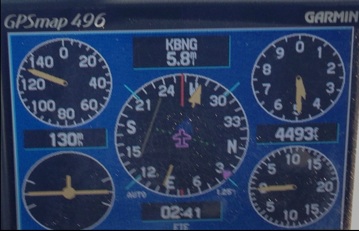
The GPS (or GPS-derived data in an iPad app) tells you the Desired Track (DTK) to a waypoint or destination. It also knows your airplane's current track (TRK). What it doesn't know (or care about) is your magnetic course or the wind.
This makes it really easy to navigate; once you're on the desired heading to go direct to your waypoint or destination (airport, VOR, landmark, etc.), simply make your Track = Desired Track, for the "shortest path between two points". Keep those two numbers locked to each other for the most direct automatic, wind-correction track.
June 2015
TRAFFIC ADVISORIEs
"Traffic in sight" or "Negative contact" are the only two acceptable phrases when responding to ATC traffic alerts.
Saying things like "We have him on T-CAS", "looking for traffic" or “we have him on the fish-finder” (c-o-r-n-y) is not acceptable phraseology. See the Pilot-Controllers Glossary for more (look under "Traffic Advisories").
The only other exception I can think of is when ATC issues a traffic alert and you're in a cloud on an IFR flight. In that case you should respond, "53-Gulf, in IMC" (since they have no idea when you are in or out of a cloud). And remember, if you lose visual contact with previously called traffic, you should report that to ATC if they are still considered a factor.
May 2015
Movement /
Non-Movement Areas
The terminology confuses some pilots. Just substitute the word 'controlled' for 'movement' for clarification.
The hangars and tie-down spots are all in non-movement (non-controlled) areas. You can walk, drive or taxi an airplane in that area without requiring clearance from ATC (some busier airports want you to call for taxi prior to leaving your tie-down spot).
April 2015
Yellow Taxi Line
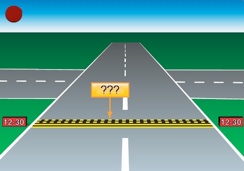
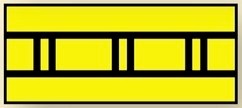
The yellow taxi line running to the center of the runway is to help guide you from the runway after landing, onto the taxiway. You're not supposed to follow it from the taxiway onto the runway when taking off, but rather should always use all available runway whenever taking off (unless performing an intersection departure).
A classic example of this is 27-Right at Gillespie, with a displaced threshold (painted white; it's available for takeoff but not landing).
When you're cleared for takeoff, you should taxi onto the runway, turn right, and use the full runway for takeoff.

March 2015
“REPORT RIGHT DOWNWIND”.
“For which runway?” In the last week I’ve heard pilots inbound to both Gillespie and Palm Springs ask the tower controller that very question after their initial call-up.
The answer to their question was on ATIS: "...landing and departing Runways 27-Left and 27-Right...", etc. ATC may not specify the runway until they have visual contact with you and clear you to land.
The whole point of ATIS is to broadcast information -- landing runways, closed runways/taxiways, split frequencies, etc. -- so ATC doesn't have to give this information to each individual pilot. Listen to ATIS.
February 2015
You can't fill the seats and fly with full fuel.
This rule is generally true for all light airplanes. For certification purposes, manufacturers only need demonstrate the airplane will fly with 30-minutes of fuel on-board, when each seat is occupied by a 170-lb. person. (FAR 23.25)
If you or any of your passengers weigh more than 170-lbs., and you want to fly for more than 30-minutes, somethin's gotta give.
This is true in Cessna 172's, Bonanza's, King Air's, Citation Jets, etc. With full fuel, the payload of the 6-seat Piper Meridian is just 561-lbs.
January 2015
BATTERY CHARGING IN-FLIGHT
Typical aircraft batteries in single-engine airplanes require about 2.5-hrs. of cruise flight to properly 'top-off' to a full charge, according to Concorde Batteries.
An airplane used only for short-hop $100 burger runs or flight training may never reach full-charge status.
And it's worse in winter; a battery which could be recharged in an hour at 77°F while flying may require 5 hours for charging when the temperature is at 0°F, which it's likely to be at 10,000'.
December 2014
Know the Rules, Not the Rule Numbers
There is no requirement at any level of pilot training that you memorize rule numbers. You will not see rule numbers referenced on any written (knowledge) test, or asked by an examiner on a check ride.
If an examiner does ask, "What does 91.103 require us to do?", ask him to re-word his question without using a rule number. When I began flying in the mid-70's, Preflight Action (91.103) was 91.5. Do you think I re-memorized the new number for that rule every time they inserted a new rule and 91.5 got bumped later and later in the regs? (No.)
Just like the DMV expects you to know the rules of the road, but not memorize the vehicle code, so too does the FAA want you to know applicable rules, but it's not a memory test, folks!
November 2014
SLOW FOR SEQUENCING
When tower/ATC gives an instruction to "extend downwind" or "make a right 360", it's for spacing/sequencing. You can minimize the amount of vectoring and how far your extended downwind takes you by simply SLOWING the airplane.
ATC is merely trying to increase distance between two airplanes, and in the time-space continuum, performing slow flight will accomplish this without traipsing all over the countryside.
Bonus tip: You can achieve a similar result when IFR and you're told to "expect a hold" for sequencing. Slowing the airplane will generally eliminate the need for a hold.
October 2014
ONCOMING TRAFFIC
Airplanes heading in roughly opposite directions to each other will be at the same position from each other.
In other words, if ATC tells another airplane to look for opposite direction traffic (you) at their "3 o'clock" or "off their right wing", then he will be at your 3 o'clock and off your right wing too.
September 2014
1-IN-60 RULE
When you are 60-miles from a VOR with 1° deflection, you are 1-mile off-course. If you can remember the ‘1-in-60 Rule’, you can calculate other off-course scenarios.
2° at 60-mi: 2-miles off course;
2° at 30-mi; 1-mile off course;
4° at 30-mi; 2-miles off course, etc.
August 2014
Double the Degrees
When trying to intercept a VOR radial, choose an intercept angle that's twice the number of degrees that you are from that radial.
Ex: You're on the JLI 190 radial, and you want to get to the 170 radial. Intercept at a 40° angle (030° heading to fly TO, or 130° heading to fly FROM the VOR).
Anything between 20-90° intercept is good; less than 20° will take forever to intercept; greater than 90° will have you going the wrong way to/from it.
VOR intercept angle is also predicated on your ground speed, and how close you are to the VOR.
July 2014
TAXI TO THE TAIL
Bug the departure runway in your HI, then just taxi toward the tail (opposite end) of what you've bugged. This is particularly helpful at non-towered airports and will almost always take you to your departure runway.

Taking off on RWY-31? Bug that, then taxi to the tail - the far end - to get to the departure end of RWY-31.
This works because there are no taxiways that extend beyond runways at airports, so taxiing as far away from the runway heading you've bugged will virtually always take you to the far end of that runway.
June 2014
LOOK BEHIND YOU
Your chance of having a mid-air collision while overtaking - or while being overtaken - is 5x greater than a head-on collision.
Look under and above your wings, and behind you while flying to or from airports, VOR's and congested waypoints.
May 2014
GLIDE DISTANCE
In the event of total engine failure, you'll be able to glide to anything that is within a circle extending from under the nose of your airplane.
The higher your altitude, the larger this arc, and your gliding distance, becomes. It's a visual thing, and works pretty well in most single-engine airplanes. See that big field that's just beyond the nose of the airplane? Odds are you won't be able to glide to it.
April 2014
Wait For The Click
When communicating on the radio, listen for the little ‘click’ at the end of the other party’s transmission that always occurs as they release the PTT button. Then, you can click your mic and transmit.
I often hear pilots talk over an ATC transmission because they wait for the end of a sentence or phrase from the controller and then key their mic, talking over the last portion of the controller’s transmission, rather than waiting to hear the click to verify that the controller (or even another pilot on 122.75 or CTAF) had indeed completed their transmission.
Interestingly I never hear controllers talking over pilots in this manner; they’re trained to wait to hear the click before keying their mics
March 2014
RESET HEADING INDICATOR EVERY 15-MINUTES
While you were in the air for an hour in your little airplane, the earth below continued to rotate on its axis another 15º.
Even the most accurate HI in the world is going to be off by 4-5º every hour or so, unless you have a “slaved” HI/HSI, in which case, never mind. (This becomes even more critical the closer you get to the poles. The formula for hourly precession is 15 * (SIN(Latitude)), for all you nerds...)
February 2014
ROLLING OUT OF A TURN
Begin to roll out of a turn at 1/2 your bank angle.
Ex: In a 30º banked turn, begin to roll-out 15º before you reach your desired heading.
January 2014
CONVERTING TEMPERATURES
A quick ‘n’ dirty way to convert Celsius to Fahrenheit:
Multiply x 1.8, then add 32.
Ex: 20° C = (20 x 1.8) + 32, or 68°F
30°C = (30 x 1.8) + 32, or 86°F
As we were raised in a Fahrenheit world here in the U.S., you really only need to know how to interpret Celsius --- how to convert C to F; you generally don't need to know how to 'go the other way' in conversions.
December 2013
POWER-OFF TRIM
In the event of engine failure, crank in full nose-up trim all the way back to the stops.
This will give you best glide airspeed in almost every single-engine airplane. It’s not a coincidence; that’s the way the elevator trim is supposed to be rigged.
Note: check this first at altitude with idling engine to verify in your airplane!
November 2013
RUNWAY WIDTHS
You can ‘ballpark’ the width of a runway by counting all the threshold stripes and multiplying by 12.
Ex: A runway has a total of 12 stripes; 12 X 12 = 144; round off to 150' width.
-
6 stripes = 75'
-
8 stripes = 100'
-
12 stripes = 150'
October 2013
Tailwind Landing
A tailwind of 10% of your final approach speed increases your landing distance by 20%.
A headwind of 10% decreases landing distance by 20%
Keep in mind, you would fly the same indicated speed for each, but your increased ground speed with a tailwind could be disconcerting if you've not previously landed with a tailwind. Also, 10% could be as little as 6-knots; land with a 10-12 knot tailwind and it will really get your attention!
September 2013
The +3 / -8 Rule
In the aviation world, Plus 3/Minus 8 refers to the first three minutes after takeoff and the last eight minutes before landing.
According to flight crash investigators, close to 80% of all plane crashes occur during this timeframe (the events leading up to the recent Asiana plane crash happened during the last 8 minutes of descent).
In between those times, the chances of a plane crash occurring drop dramatically. Thus, if you want to up your chances of survival, you need to be extra vigilant and ready to take action during the first 3 minutes after takeoff and the last 8 minutes before landing.
Click here for suggestions from The Survivor's Club on what to do and not do during Plus 3/Minus 8.
August 2013
Looking Outside the Airplane
For every 3-seconds you spend looking inside the airplane, you should spend 17-seconds looking outside the airplane while in visual flight conditions.
The Navy teaches this 3:17 time-slicing concept. Look outside; peek inside. Remember, you are responsible for terrain and collision avoidance whenever you are in VMC, even if on an IFR flight plan! .
July 2013
CORRECTING ALTITUDE DEVIATIONS
For errors less than 100’, use 1/2 bar width on the Attitude Indicator to correct. For deviations greater than 100’ use 1 bar width of elevator correction.
A good rule of thumb is to use a vertical speed rate that is double the error. Ex: for 100’ deviation, correct at a rate of 200 FPM on the VSI.
June 2013
V-speeds, under MAX GROSS WEIGHT
Vx, Vy and Vg (Best Glide) all decrease ~ 1/2 knot for each 100-lbs. under maximum gross weight.
For example, flying with one passenger and half fuel you might be 500-lbs under MGWT. Reduce those three V-speeds by about 3-knots to truly achieve Best Angle and Rate of Climb and Best Glide!
May 2013
POLARIZED SUNGLASSES
The plastics used to create the windows in most airplanes already serves to minimize glare (unlike the safety glass used in automobiles). Using polarized sunglasses will further eliminate light reflection and sparkles, making it difficult to see nav lights or airplanes in the air.
Furthermore, polarized sunglasses will reduce or eliminate the visibility of instruments that incorporate anti-glare filters (including iPads!). Use them to look cool and avoid glare on the beach, water or snow, but not when flying an airplane. Learn more about what the FAA has to say about sunglasses from this safety brochure – click here to read the PDF.
April 2013
Rotation Speed
Rule of thumb in a single-engine airplane is to rotate at 1.15 x Vs. If stall speed is 50; you should rotate at about 58.
Recall that 'rotate' does not mean 'takeoff'; the FAA defines it as "the speed at which the pilot makes a control input, with the intention of lifting the airplane out of contact with the runway".(FAR 21.51(a))
You are merely applying back pressure on the elevator to get the wing to an angle of attack that will produce enough lift to slip the surly bonds of earth once lift is greater than weight.
March 2013
Turning With Traffic in Front of You
The rule of the thumb is that if the other airplane is similar to yours (single engine piston, etc.), when traffic is abeam your wing, you can turn without worry that you will ever 'catch up' to the other plane.
This is particularly helpful in the traffic pattern for maintaining a safe sequencing distance. Of course, just like in a car, look first before you begin any turn!
February 2013
Touching down left of centerline?
Probably not using enough right rudder in the flare. Remember, as you increase angle-of-attack in the flare, P-Factor kicks in --- the right (descending) blade produces more thrust than the left, creating a left yaw moment.
Trying to correct it with aileron? Well, that only makes things worse as adverse yaw greatly increases at high angles of attack. So, although you may land somewhat straight, insufficient right-rudder in the flare has allowed the airplane to drift left of centerline in the final moments.
January 2013
Turning While Taxiing
When taxiing a 3-wheel vehicle like an airplane, you should not begin any turn at a speed greater than that from which you would be able to come to a complete stop with only minimal braking.
Just like on a motorcycle, you want to brake only while going straight --- if you have to brake in the turn, you entered the turn too fast!
Tip: When you are cleared to land, you own the runway for your operation. Other than a LAHSO you have accepted, there is no requirement that you "turn off ASAP... or turn off at Bravo...". If you need to roll out all the way to the end of the runway, do it --- it's your runway! And there is always a taxiway turn-off at the end of the runway, right? It's the departure entry point for the reciprocal runway!
December 2012
SURVIVING AN OFF-AIRPORT LANDING
The typical light airplane is designed to provide protection in crash landings that expose the occupants to nine times the acceleration of gravity (9 G) in a forward direction. Assuming a uniform 9 G deceleration, at 50 mph, the required stopping distance is 9.4 feet.

November 2012
Airplane Shadows
When you see the shadows of your airplane and another airplane on the ground, there is no chance of collision if they are in different places.
Only when the other plane's shadow is close to overlapping your own plane's shadow is there a threat of collision.
October 2012
Weather in a Low
Look for the worst weather in the northeast corner of a Low.
That's where the cyclonic force of the Low takes the warmer air north to meet cold air from the polar region as it sags southward.
This is true in North America; not so much in Australia!
September 2012
MAXIMUM RANGE AIRSPEED
Last month I suggested you could stay in the air as long as possible (Maximum Endurance) by flying at approximately 1.3 x Vso.
To gain the most distance possible with fuel remaining requires a slightly faster True Airspeed. The rule of thumb for Maximum Range is to fly 1.5 x Vso.
Ex: If straight & level stall speed is 44-kts, maximum range speed is about 66-kts (at Max. Gross Wt.). When you see how slow this really is, most people (especially those flying rental aircraft) will choose to fly much faster and burn more fuel in exchange for reduced range.
August 2012
MAXIMUM ENDURANCE AIRSPEED
If you want to keep flying as long as you can (duration; not greatest distance), slow the plane to approximately 1.3 x Vs.
Ex: If straight & level stall speed is 44-kts, maximum endurance speed is about 57-kts (at Max. Gross Wt.). Handy to know if you happen to rent a plane "dry" (you pay for the fuel used)!
July 2012
High to Low (or Hot to Cold); lookout below!
When flying from an area of high(er) pressure to an area of low(er) pressure, your actual altitude will be lower than what is displayed on your altimeter (until, of course, you reset it to the new setting). This is also true when flying from an area of warm(er) air to an area of cold(er) air.
Try it for yourself: At altitude, set your altimeter to a somewhat lower barometric setting, and watch the hands on the altimeter begin to unwind!
June 2012
WIND DRIFT CORRECTION WHEN TRACKING A VOR.
Double the number of degrees you are off course.
Ex: If you are 2 dots (4° )off course, correct by turning 8°. When back on course, correct the other way by half that angle (4°) to stay on course with a correct wind correction angle.
This process is known as 'bracketing' and epitomizes the concept of small, minor corrections made early.
May 2012
FINGER MEASUREMENTS
This Rule of Thumb could be called a Rule of Finger. Find one of your fingers that corresponds to a rough nautical mile distance on a sectional chart.
In my case, the length of my index finger happens to be almost exactly 20nm on a Sectional (10nm on a Terminal Chart). When I need to do a 'quick guesstimate' of distance, no need to reach for my plotter/ruler --- 3 fingers is 60-miles; 2 fingers is 40 miles, etc
April 2012
MAXIMUM GLIDE DISTANCE
Most single engine light airplanes will glide approximately 1-mile for each 1,000' of altitude above ground without power. This assumes you descend at Best Glide airspeed (L/D Max), which decreases from the POH maximum gross weight speed, proportionate to how much under MGWT you are.
Keep in mind you will also enjoy a better glide ratio in straight flight, compared to turning flight, and while staying coordinated, rather than slipping or skidding!
March 2012
CALCULATING MANEUVERING SPEED
You can obtain a rough estimate of Va by multiplying the 'clean' (Vs1) stall speed by 1.7. Ex: Plane stalls at 54kts; use 92 as Va at that gross weight.
Va is the maximum speed where full abrupt movement of one primary control (aileron, rudder or elevator) can be used without overstressing the airframe. It varies in relation to max. gross weight.
February 2012
Emergency Landing At Night
If you're forced to make an emergency landing at night, sometimes the best option is on a big ol' 2-lane interstate highway.
In that case, land with the red lights (with flow of traffic), rather than the white lights (oncoming cars)!
January 2012
CLIMB AT HIGH DENSITY ALTITUDE
Rate of climb is reduced about 7% for each thousand feet of Density Altitude. (8% above 8,500’ DA).
Example: At 5,000’ Density Altitude (French Valley on a hot summer day); Rate of Climb will be at least 35% less than at Sea Level!
December 2011
Gust Factor on Landing
Rule of thumb is to add HALF the wind gust factor to your final approach IAS. If normal approach is 65kts, and wind is down the runway at 15G25, add half the gust factor of 10 --- or 5 knots --- resulting in an Indicated Airspeed of 70kts.
Also consider using partial flaps with a strong or gusting headwind component. Your lower groundspeed will shorten your ground roll, and full flaps with strong/gusty wind could result in weathervaning or directional control issues on rollout..
November 2011
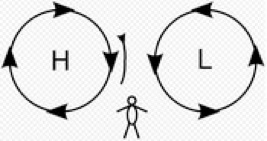
Knowing Where Low Pressure Is
Stand with your back toward the wind. Extend your left arm out to your side and point. That's where the low pressure is (high pressure is to your right).
October 2011
Clearing a Mountain
As you approach a mountain, if you can see an ever-increasing number of objects (houses, roads, trees, etc.) on the far (leeward) side of the mountain, you are higher than the mountain.
If you see fewer and fewer objects on the far side of the mountain as you approach it, you are lower than the mountain. This works particularly well at night, regarding the changing number of lights on the lee side of the mountain (there's either gonna be more of 'em or less of 'em!)
September 2011
VY With High Density Altitude
Vy decreases approximately 1 knot for each 1000' of Density Altitude.
Ex: Hemet on a 97° day, DA can easily approach 5,000'. Your 'book' Vy of 79 is really closer to 74KIAS. Remember, Vy decreases with altitude, as Vx increases with altitude --- until they converge at max. L/D (best glide speed) at the airplane's absolute ceiling!
August 2011
Standard Rate Bank Angle
Take the first 2 digits of your IAS (in knots), and add 7. That's roughly the bank angle that will produce a standard rate turn.
Ex: IAS is 130 knots. Take the '13', add 7, resulting in 20. A 20° bank angle will produce a standard-rate two-minute turn. (Add 5 instead of 7 if IAS is in MPH).
July 2011
ESTIMATING FUEL FLOW
Multiply the horsepower by .06 (or 6%).
Ex: 100HP burns about 6-gph; 235HP about 14-gph; 300HP about 18-gph.
June 2011
CRUISE-CLIMB AIRSPEED
Add the difference between VY and VX to VY..
Ex: VY is 79, VX is 63; a difference of 16- knots. Add 16 to VY (79); an efficient enroute climb speed would be 95-knots.
May 2011
CROSSWIND COMPONENT

Ex: 30° off the nose; x-wind component is 50% of wind velocity; 45° off nose; x-wind is 75% of wind.
April 2011
BEST GLIDE SPEED
VS X 1.6
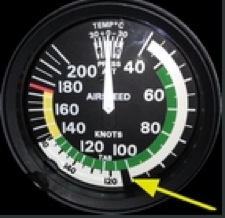
VS is the speed at the bottom of the green arc.
If you’re under Maximum Gross Weight, decrease Best Glide by that same percentage.
Ex: VS is 44-knots, and you’re 20% under MGWT. Best Glide is approximately 56-knots. (44 X 1.6 is 70. Reduce this by the same percentage you are under MGWT, 20%, to arrive at 56-knots).
March 2011
DESCENT RATE
3 X Altitude to lose (in 1,000’s) = Miles out to begin descent
Groundspeed X 5 = FPM descent rate
Ex: You’re at 12,000’ and want to be at 2,000’ over the airport. 10(000)’ to lose X 3 = begin descent 30-miles out.
GS is 120 kts. X 5 = 600 FPM descent to get there!
February 2011
RUNWAY GRADE
For every 1% airport grade it will affect the aircraft by 10% over what is stated in the POH for performance.
Ex: For a 3% uphill grade, add 30% to takeoff runway calculations.
January 2011
TAILWIND ON LANDING
Add 20% to the POH stopping distance for every 5 mph of tailwind component.
Ex: Landing with a 7-knot tailwind component will increase required landing distance (and ground roll) calculations by about 30%.