



There’s an old meteorological joke; “The guys down at the National Weather Service just got a new, high-tech weather forecasting tool --- a window!”
The flat screen technology that is now available in single-engine light airplanes is just staggering. It truly is more advanced than what was available to NASA in late Gemini and early Apollo missions. With this incredible functionality comes complexity. The more information available to you, the more time and attention required to digest, process and act on it all. In another life, I designed and wrote elaborate marketing software products used in large outbound call centers. Clients would ask for 100 different features that would give them incredible flexibility, at the cost of increased complexity. Some of these requested features would be so detailed and specific, that it was clear to me that they would never be used properly, as it would be too complicated to even implement. Improved flexibility always leads to increased complexity. That’s the trade-off.
WHAT’S IT DOING NOW?
Some people new to general aviation want to learn to fly in the most modern, most technologically advanced airplane possible. This may not be a wise decision. You must have a solid understanding of the fundamentals of flight before you should think about layering on additional elements such as the ‘whiz-bang’ technology available to you in the cockpit, which is sure to distract you from what is required to just fly the airplane,.
If you don’t understand what the rudder is --- why it was designed and how and when to properly use it --- no amount of moving map, weather, traffic or engine data on a glass panel is going to help you properly fly an airplane. In fact, it is almost sure to preclude you from learning to fly correctly; at least in the shortest amount of time possible.
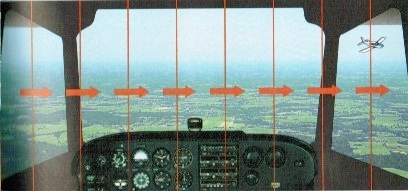
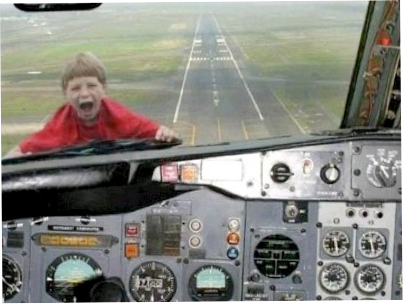
So I’ll get off my soapbox about glass panels now; the chapters and pages and menu trees and what series of buttons you push to add 28-gallons to your fuel remaining quantity and get to my real point, which is to get you to use the original glass panel --- those windows in front of and around you!
“I’VE GOT HIM ON T-CAS”.
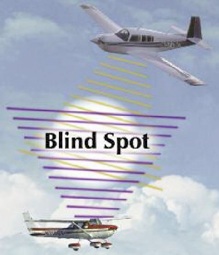
According to the AIM [4-4-14 (2.)], “A pilot sees the other aircraft… and upon instructions from the controller provides separation by maneuvering the aircraft to avoid it… pilots… must maintain visual surveillance…” The note under 2.b of this section goes on to state, “… the pilot should promptly notify the controller if visual contact with the other aircraft is lost or cannot be maintained or if the pilot cannot accept the responsibility for the separation for any reason.” (Also, 4-4-16(3.c) states, “TCAS does not alter or diminish the pilot’s basic authority and responsibility to ensure safe flight.”)
“YOU CAN OBSERVE A LOT JUST BY WATCHING”
That famous Yogi Berra quote should be the cornerstone of your VFR flying. Here are some techniques that may help you see as much as possible.
Prior to taxiing onto a runway –
-
•Scan the approach areas for possible landing traffic
-
•Towered: Scan Base & Final legs --- don’t rely on the government contract employee in the Tower!
-
•Non-towered: 360° turn in run-up area (not everyone has or uses a radio!)
During Climbs & Descents–
-
•Execute gentle banks left & right to permit continuous visual scanning
-
•Occasionally lower the nose
-
•Don’t forget to occasionally look behind you for faster, overtaking aircraft!
Before Turns and Maneuvers–
Clearing procedures
Types of clearing turns –
-
•Two 90° turns in opposite directions
-
•One 180° turn in either direction
-
•A 360° turn when approaching practice area
When to use clearing turns –
-
•Before all turns, climbs, descents
-
•Before executing any maneuver
Tip: Raise/lower wing momentarily before beginning clearing turn in that direction to check for traffic
Avoidance Strategies –
-
•Fly at the correct altitude! (Hemispheric rule)
-
•Avoid congested airspace
-
•Victor airways, VOR intersections & VFR Waypoints are all hotspots!
-
•Active MOA’s, Warning & Alert areas
-
•Lights On! Strobes, beacon, landing light.
-
•Sterile cockpit procedures
-
•Flight following on VFR flights
-
•Be extra-vigilant at non-towered airports!
Physical factors affecting vision –
-
•Fatigue
-
•Age
-
•Residual alcohol in the bloodstream
-
•Lower oxygen levels (high altitude; smoker; other lung deficiencies)
Physiological factors affecting vision –
-
•Binocular vision
-
•Head in motion creates blurriness
-
•Time to change focus (from instrument panel to 5-miles away)
-
•The brain better believes what it sees with both eyes.
Environmental factors affecting vision –
-
•Haze, fog, smoke, volcanic ash
-
•A moonless, featureless night sky
-
•Empty Field Myopia
-
•Flight over open water
-
•An obscured horizon
-
•Sunglasses: good – Polarized lenses: BAD!
-
•A dirty windshield
Object factors affecting vision –
-
•Distance from the object
-
•Size, shape & movement of the object
-
•Amount of light reflected by object
-
•Object’s contrast with surrounding environment
The Navy teaches a 16:4 outside:inside time slice paradigm to new pilots. This dictates that they should spend just 4-seconds looking inside the airplane (scanning panel and engine instruments), and 16-seconds looking outside the airplane (attitude, situational awareness and collision avoidance). This would be a good starting point that all VFR pilots should adopt.
Additional Resources
As an example of how much we don’t see, take this test and count the number of times the players in white t-shirts pass the basketball:
Click here for YouTube video.
The FAA’s AC90-48c has more information on clearing procedures and visual scanning. Download: AC90-48c.pdf
The Air Safety Institute has a handout on collision avoidance and visual scanning: ASF Collision Avoidance.pdf
© 2011 Garry Wing
![The [Original] Glass Panel](15_The_%5BOriginal%5D_Glass_Panel_files/shapeimage_4.png)



