


Recently the folks at American Legend Aircraft Company asked me to write an article for their Legend Magazine, to be distributed at April’s Sun ‘n’ Fun. I addressed three-point (full-stall) landings in a tailwheel airplane; specifically the Legend Cub. To read the article on-line, click here (there are also other pictures of ‘Big Al’ throughout the magazine). Here is the text of the article I wrote:
_________________________
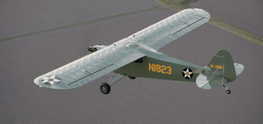

Learning to land a Cub will take about 60-70 practice landings with a good instructor. It’s easy to mount a GoPro or Contour camera on one of the overhead trusses in the cockpit. Going home to watch video of your lessons will help you see the good, the bad and the ugly as you learn to land, and you’ll progress much more quickly.
Here are a few of my favorite tips and observations to help pilots transitioning to tailwheel airplanes, specifically regarding 3-point landings:
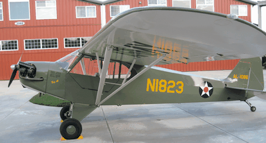
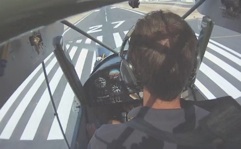
>>> If the wing is not fully stalled when the wheels touch, that means you are too fast, and that’s because you’re not close enough to the critical angle of attack! The wing will still want to fly, and the plane will momentarily take off again after the wheels briefly touch. We call this a bounce.
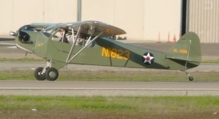
>>> In the Legend Cub, if you do not have the stick all the way back when the wheels touch, there is about a 99.9% chance you are going to ‘bounce’. The goal is to dissipate energy (airspeed) when you are 3” over the runway with smooth, gradual, continual back-pressure on the stick until you can get the wheels to touch at the same moment the stick has reached its full aft position ---- that’s a true 3-point landing!
-
->>> Always keep the nose pointed at the far end of the runway. You do this with rudder inputs. To keep the airplane over the centerline, use the ailerons.
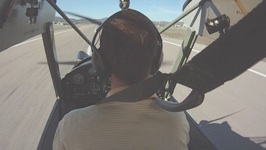
-
->>> Small control inputs early are always better than large inputs later.
>>> Pitch for airspeed; power for descent. If you can dial-in 50mph on short final you’ll greatly minimize your float down the runway as you dissipate energy (in the form of airspeed) before you land.
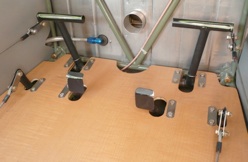
>>> If it ever starts to get wonky, simply power up and go-around. No good can come from keeping the wheels on the ground when the plane is not under control. Get it back in the air and dial it in on the next landing.
>>> I notice a lot of pilots correcting a pitch, airspeed or runway centerline issue with power or control inputs --- but then forgetting the second part of that --- to then neutralize the power or input control. If they’re too low, for example, they correct with power and get back to glidepath, but then fail to neutralize power, and proceed to climb above glidepath, creating an unstabilized approach.
>>> Whatever aileron and rudder inputs you are using to correct for a crosswind over the fence will have to be increased as the plane decelerates during roll-out and control effectiveness lessens. Don’t make a decent landing then lose control when you’re turning onto the taxiway!
>>> Bounces are OK; PIO’s (Pilot Induced Oscillations) are not. If you bounce a 3-point landing, it means you were too fast when you let the wheels touch; the wing had not exceeded the critical angle of attack and was not stalled. Power up, level off and try it again 300’ down the runway (remaining runway permitting), or power up and go around. Don’t try to fight the oscillations after a bounce; they generally never get better.
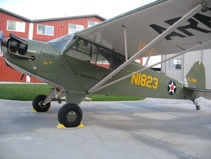
Garry Wing is a Commercial Pilot, CFI and American Legend Cub owner. He’s been flying light airplanes for nearly 40-years and resides in San Diego, CA. He can be reached through his website, www.FlyTheWing.com
© 2013 Garry Wing





