

SEE AND AVOID
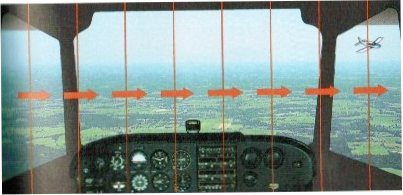
First, remember that pilots are responsible for collision avoidance in visual conditions, even if you're on an IFR flight plan (FAR 91.113b). A common misconception is that the tower controller is somehow responsible for traffic avoidance in his control area. Controllers will often point out traffic to you, but that is merely a gesture they provide on a workload-permitting basis (when they're not too busy), and not a requirement. Their primary responsibility is to play traffic cop for those big slabs of concrete known as runways, not for airborne traffic. Same for VFR Flight Following (SoCal, etc.) and IFR flights in VMC --- it is the pilot that is responsible for maintaining collision avoidance with other airplanes (and terrain); not the controller.
TIS-B and ADS-B traffic are wonderful things, but it's not going to help you much in and around an airport. Most traffic in the pattern is masked on radar (at Gillespie, you don't show up below about 1,100' MSL; at Ramona they don't see you below 3,400' MSL). If that means you're not showing up on their radar, it also means you won't see them on your on-board whiz-bang traffic system (except if you have ADS-B, you will see other ADS-B/Out traffic). And in the traffic pattern, you should be looking out the windows of your airplane, not looking at a TV screen on your panel, anyway. This situation is even worse outside the Mode-C veil. I have ADS-B in the Skylane, and I never see traffic at French Valley or Hemet while I'm in the pattern or overflying those airports.
THE EYES HAVE IT
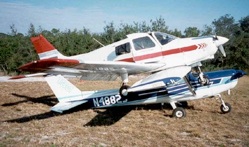
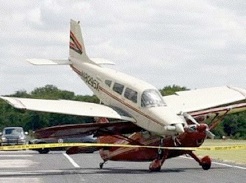
Don't forget to look behind you; especially as you approach VFR Reporting Points (Lakeside, Cottonwood, Alpine, etc.), and while you’re entering, departing or in the traffic pattern. I was at SAA nearly 10-years ago when we lost a very talented CFI and student when they departed Gillespie in a 172 and got run over from behind by a faster 182 departing the parallel runway (who also happened to not have his transponder turned on, which sealed their fate as he completed another link in the accident chain). When climbing out, lower your nose from time to time and look for other traffic that you might otherwise be climbing into, such as me flying my Cub; also known as “the-slowest-thing-in-the-air”.
While cruise-climbing to altitude for a cross-country flight, in addition to dropping the nose periodically throughout the climb, gently bank left and right to produce mini- clearing turns. Be extra vigilant crossing over VOR's, VFR waypoints and when making long straight-in approaches to airports. There is almost always an Instrument approach --- pretty much straight in to one or more runways at most airports --- so there may be pilots or Instrument students practicing that approach, or flying it for real, and I guarantee you they are not looking outside for other traffic when they're working hard to keep ILS or RNAV needles centered in their airplane.
CLEARING TURNS!!!
For students or pilots training and practicing maneuvers, you must do clearing turns every couple of minutes. I think that other than repeating “right rudder” a thousand times, this is the thing I always have to remind students. I don't know if they think that it's not necessary or some task that the FAA has added to check ride maneuvers just to make them more complex, but I rarely find a student that will do clearing turns before every other maneuver without being coached to do so. In the flight maneuver videos I've produced, I generally edit out things like clearing turns, radio calls, sweep checks and the fact that I am always over an airport or other emergency landing area, but you must know that I do them all the time; you're just not seeing that in the completed video, so perhaps that important part of the maneuver doesn't sink in.
X-RAY VISION
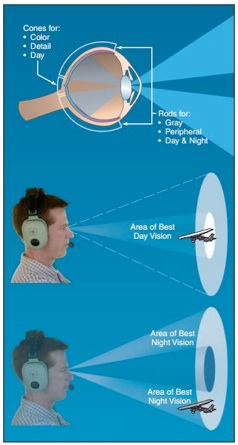
Don't use polarized sunglasses as they merely filter bright light, which is what you need to see reflecting off of airplanes out there. Aircraft plexiglass (and instruments and iPads) are already polarized to minimize glare, so if you wear polarized sunglasses it's going to make it more difficult to see airplanes in the sky.
Fixation on looking only in the direction your airplane is going is a common error, most likely a habit that is carried over from driving a car. Most mid-air collisions are not head-on; they are either at an angle or from behind/over/under your airplane. Spend a portion of your time looking outside the airplane in directions other than just directly in front of you.
When overflying airports on cross-country trips, monitor CTAF or Tower, even if you don't intend to land there. I've improved my awareness of arriving and departing traffic and avoided a couple close calls while flying over airports like Palomar and Montgomery (in pre-ADS-B days) simply by overhearing controllers point out traffic (me) to other airplanes.
OPERATION LIGHTS ON
The FAA’s voluntary pilot safety program, Operation Lights On, encourages the use of your landing light during takeoff, and whenever you’re below 10,000’ or within 10-miles of an airport. If you’re flying an airplane with an LED landing and/or taxi light, leave it on all the time --- those things will be around long after we’re all gone.
Your rotating beacon should be on prior to engine start. Prior to taxi you should turn on navigation, position and anticollision lights (and Transponder on ALT!). For more, please review AIM 4-3-23.
THE MORE YOU KNOW
The previous article I posted, Edge of the Envelope, also has some good tips related to flying an airplane near airports and below 1,500’ AGL; click here to read it.
Here are a couple other things to take a gander at:
AIM 4-4-14 offers visual separation and scanning techniques.
AIM 4-4-15 has some tips on visual clearing procedures – Takeoff, climbs, descents, traffic patterns, VOR's, during training operations
Did you know you are supposed to report any near mid-air collision of < 500'? Review AIM 7-6-3 and then tell ATC: “I wish to report a near mid-air collision”. You can do that on the radio or by phone to the nearest FAA ATC or FSS facility, or in writing, to your local FSDO.
AOPA has put together a great Safety Advisor PDF relating to collision avoidance. Download it by clicking here.
The FAA’s Advisory Circular, AC 90-48C covers Pilots' Role in Collision Avoidance. This 32-year old document contains lots of good information relating to traffic patterns, scan techniques, and communication suggestions. Click here to download the PDF.
Fly safely out there, and keep your head on a swivel!
© Garry Wing 2015